Will rebar keep my slab from cracking?
Short analysis of what rebar does in concrete and what can be done to reduce cracking in new concrete.
5/15/20263 min read
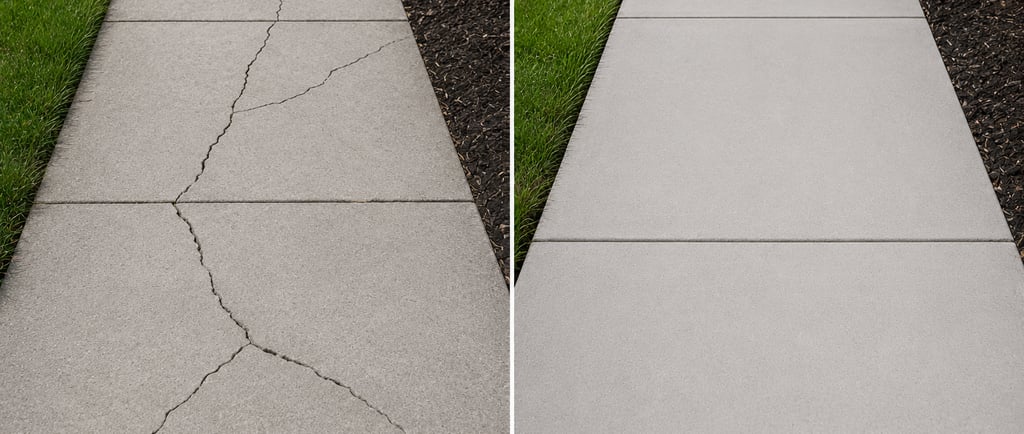
🧱 Will Rebar Keep My Concrete From Cracking?
Short answer? It depends.
I know, that’s a frustrating answer. But if you’ve spent any time around concrete, you’ve probably heard the saying:
“Two guarantees: it’s gonna get hard, and it’s gonna crack.”
There’s truth to that—and the reason lies in what concrete actually is, how it cures, and what rebar really does (and doesn’t) protect against.
🧪 Let’s Back Up—What Is Concrete?
I’m not an engineer or a lab coat guy. I’ve just been pouring concrete for 22 years, and here’s what I’ve picked up in that time.
Concrete is made up of:
Cement
Sand
Aggregate (rock)
Water
And some chemical admixtures
Once you add water to the mix, the cement starts a chemical reaction that bonds it all together. Too much water? Weak concrete. Too little? Also weak. That’s why there are people at the batch plants who nerd out on mix design.
Once the truck rolls out of the yard, the clock starts ticking.
⏱️ The Pour Starts the Countdown
From the moment concrete hits the ground, it’s reacting to everything:
Temperature
Airflow
Soil moisture
Shade vs. sun
As it dries, it starts to shrink. That shrinkage is where the first battle begins—especially with slabs poured on vapor barriers or with wide areas open to air which are also proportionally thin.
🔄 The Curling Problem
Concrete slabs generally dry from the top down. The surface shrinks first, while the bottom stays wetter. That creates curling tension—the slab wants to lift slightly at the edges or corners. That tension can lead to cracking, especially in thinner pours.
Now here’s where rebar steps in.
🧰 What Rebar Actually Does
Rebar doesn’t stop concrete from cracking altogether.
What it does is:
Resist tension
Hold the slab together when cracks happen
Reduce curl cracking when it’s placed low in the slab
Carry load stress when placed correctly for that load
Concrete is super strong in compression. But in tension? Not so much. That’s why you add rebar—it takes over where concrete is weak.
If you’ve got proper rebar placed in the bottom third of the slab, it helps hold everything in place during curing, shrinkage, and even future use. Rebar is ribbed so the concrete locks onto it as it sets—so even if a crack forms, the pieces are still tied together. If you have a load pushing down on a slab, especially in a cantilevered application, then the rebar might have to be in the top ⅓ of the loaded area, or both if the situation calls for it.
❌ So Why Does Concrete Still Crack?
Because it’s still shrinking.
Even with rebar, you’ve got different parts of the slab drying at different speeds. Full sun vs. shade, corners, intersections, walls—each one pulls and dries a little differently. And sometimes, it just finds the weakest point and cracks there.
You can’t always stop that. But you can try to control where it cracks.
✂️ Control Joints: Let It Crack Where You Want
This is why we put cut lines in the slab:
Wet cuts (tooled in for decorative work)
Dry cuts (cut with a saw for garages, shops, sometimes also decorative work)
Cuts are like pre-set weak points. They encourage the crack to happen in a straight line, not randomly through the middle of your driveway. For effective use, they really should be close to 25% of the way through the concrete.
General rule:
4” slab → cuts no more than 8’ apart
6” slab → up to 10’
Always try to cut off of inside corners, which are crack magnets. And if you’re pouring against an existing slab or wall, its generally a good idea to add an expansion joint to give the new concrete space to shrink without locking against the old stuff.
🧱 What About the Base?
Here’s the thing: your slab is only as good as what’s underneath it.
A poor base with soft spots or voids will make the slab flex, and flexing = cracks. Doesn’t matter how much rebar you throw at it.
Compact the base rock tight and consistent, especially if you’re trying to control where cracks go.
💣 Wild Cards
Even if we do everything right—tight base, good rebar, smart cuts—sometimes concrete still does what it wants.
All it takes is:
A weak piece of aggregate
An air pocket
A hot sunny edge
And a crack might show up just outside the cut line.
That’s why we use rebar on almost every pour. Even when cracks happen, rebar keeps the slab from separating, which prevents lifted edges and major structural problems down the road.
🧪 Are There Additives That Help?
Yep. There are:
Plasticizers
Shrinkage reducers
Fiber mesh
Internal Cure
Colloidal Silica
They help, but they cost more. Depending on the season and the slab, we recommend using some of them all the time, and others on a case by case basis. But good placement, compaction, cut patterns, and rebar get you 90% of the way there on most jobs.
✅ The Real Answer
So, will rebar stop your slab from cracking?
Not always. But it will stop those cracks from becoming a real problem.
It’s part of the system:
✔️ Smart pour timing
✔️ Consistent base
✔️ Proper reinforcement
✔️ Controlled cut patterns
✔️ Good finish work
You don’t control one variable—you control all of them. And that’s what creates long-lasting concrete work.
Core Values (CRETE)
Courtesy
Serve with professionalism and initiative.
Respect
Respect people, property and the job-site.
Excellence
Do quality work and never cut corners.
Truth
Be honest, clear, and upfront.
Energy
Show up with urgency, positivity, and purpose.
Contact:
Phone: 541-422-6884
Email: info@firmfoundationsconcrete.com
Fully licensed, Insured and Bonded. CCB# 203408