Do I Need a Retaining Wall? What Matters in Southern Oregon
When a retaining wall is worth it, what makes one fail, and how drainage, footings, and the hillside affect the job in Grants Pass and the Rogue Valley.
11/20/20264 min read

Do I Need a Retaining Wall? What Matters in Southern Oregon
A straight look at when a wall is doing real work, when it is mostly for looks, and why drainage matters as much as the concrete.
🧱 The Short Answer
If the ground is trying to move downhill, or you need a flat place to live, park, or build on a slope, you probably need a retaining wall. If you just want a raised planter or a little definition in a flat yard, you might need a wall, or you might just need a grade change and some landscaping.
The difference matters, because a real retaining wall is a structure. It has to hold soil, handle water, and stay put. That is a different job than a low decorative curb.
🌧️ What the Wall Is Actually Fighting
In Southern Oregon, a lot of the hard ones are hillside lots. Grants Pass, the Applegate, Jacksonville, Merlin, and the edges of the Rogue Valley are full of them. The soil wants to creep, and water wants to run behind whatever you build and push on it.
That is the part people underestimate. A wall can hold a lot of dirt if the footing is right and the water has somewhere to go. If water sits behind the wall, it gets heavy, it freezes and thaws, and it will find a way to move the wall. I have seen pretty walls lean over in a few seasons because nobody put drain rock and a drain pipe behind them.
So when someone asks, "Do I need a retaining wall?" I am really asking three things:
Is the grade going to keep sloughing if we do nothing?
Are we trying to make a usable pad, driveway, or yard on a slope?
Is water already tracking through that slope?
If the answer to any of those is yes, a wall is usually the honest fix. If the answer is "I want it to look nicer," we can still build a wall, but we should size it for the dirt and the water, not just the look.
🏠 Basement Walls and Landscape Walls
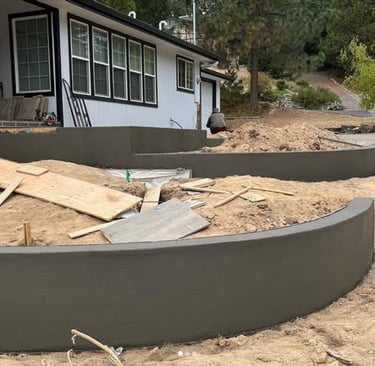
We build new retaining walls both ways: basement walls that are part of a foundation, and freestanding or hillside walls that hold grade and keep erosion in check. Most of the walls we build are poured concrete. We also build block walls when that is the right fit for the job.
A basement wall is holding the house and the hill. The steel, the footing, and the drainage all have to match that job. A landscape wall might be shorter, but the same rules apply. Short does not mean you can skip the footing or the drain. A three-foot wall with a wet hillside behind it is still doing structural work.
🚧 Why a New Wall Has to Be Built as a System
Most failed walls I see were not "bad concrete." They were a bad system.
No drain behind the wall, or a drain that dumps into the footing instead of away from it
No drain rock, or dirty rock that silted up
Footing that is too small, or not deep enough for the height and the soil
A wall asked to hold more height or a steeper cut than it was built for
Water from a downspout, a driveway, or a neighboring lot added later, with no path around the wall
Roots, settlement, or a poorly compacted backfill
That is why a new wall has to be built as a system, not just a vertical face of concrete. If you need a new wall on a Grants Pass or Rogue Valley lot, request a quote.
📏 What Goes Into the Job
A proper wall is more than the face you see when it is done.
You need a footing sized for the height and the soil, steel where the wall will be in tension, a drain path behind the wall, clean drain rock, and backfill that does not turn into a sponge. Access matters too. If a concrete truck cannot get close to the pour, we may need to pump, and that is quoted at the site visit, not buried in a starting range. Our calculator asks about truck reach and access for that reason, and it can give you a starting range for a retaining wall.
Pick a wall based on the height, the drainage, and what it has to hold, not just the face. You can see some of our wall and foundation work in the gallery.
🌲 Southern Oregon Odds and Ends
Hillside lots in the trees stay wet longer, so plan the drain as if the wet year is normal. Irrigation and roof drains should not dump behind the wall. If the wall is near a driveway or parking pad, the load on top of the retained soil is part of the design, not an afterthought. And if you are already building a new foundation in Grants Pass, it is cheaper to get the grade and the wall right the first time than to squeeze a wall in later.
✅ Bottom Line
You need a retaining wall when the ground, the water, or the way you want to use the lot requires one. You do not need one just because a slope exists. When you do need one, build it like a structure: footing, steel, and drainage, not just a vertical face of concrete.
If you are trying to decide whether your Grants Pass or Rogue Valley lot needs a wall, request a quote, call (541) 422-6884, or run a starting estimate. And if you are also pouring a patio or driveway at the base of that wall, Will rebar keep my slab from cracking? is worth a read before you sign off on the slab.
Core Values (CRETE)
Courtesy
Serve with professionalism and initiative.
Respect
Respect people, property and the job-site.
Excellence
Do quality work and never cut corners.
Truth
Be honest, clear, and upfront.
Energy
Show up with urgency, positivity, and purpose.
Contact:
Phone: 541-422-6884
Email: info@firmfoundationsconcrete.com
Fully licensed, Insured and Bonded. CCB# 203408
Firm Foundations Concrete Specialists is a DBA of Jeremiah Fear Construction LLC